几何群论笔记
几何群论笔记(二):融合积与正规形
1 Direct limits
Let \(I\) be a set. For each \(i\in I\), let \(G_i\) be a group. For \(i,j\in I\), let \(\mathcal F_{ij}\) be a possibly empty set of homomorphisms from \(G_i\) to \(G_j\).
Definition. The direct limit of the \(G_i\) relative to the \(\mathcal F_{ij}\), denoted by
is a group together with homomorphisms \(\iota _i:G_i\to G\) satisfying the following universal property:
For every group \(H\) and every family \(h_i:G_i\to H\) such that \(h_j\circ f=h_i\) for all \(f\in \mathcal F_{ij}\), there exists a unique homomorphism
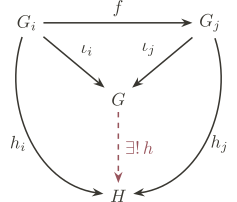
Example. Take \(G_0,G_1,G_2\), with
Then \(\varinjlim G_i\) is the pushout of the diagram
Proposition. The direct limit \(\varinjlim G_i\) exists and is unique up to isomorphism.
Proof. Uniqueness follows from the universal property. For existence, let \(G_i=\langle X_i\mid R_i\rangle \). Write
Let \(j_i:G_i\to *_{i\in I}G_i\) be the canonical homomorphisms and define
Suppose \((H,h_i)\) satisfies \(h_i=h_j\circ f\) for every \(f\in \mathcal F_{ij}\). The homomorphism on the free product determined by the \(h_i\) respects these relations, so it induces
This is the required homomorphism.
2 Amalgamated products
For homomorphisms \(G_1\xleftarrow {f_1}G_0\xrightarrow {f_2}G_2\), the group
is called the amalgamated product of \(G_1\) and \(G_2\) along \(G_0\).
We will assume that the maps into the factors are injective. Otherwise the resulting group might be trivial. For example, let \(A,B\) be finite simple groups, and choose \(1\ne a\in A\), \(1\ne b\in B\) with
Let \(f_1:\mathbb Z\to A\), \(1\mapsto a\), and \(f_2:\mathbb Z\to B\), \(1\mapsto b\). Then \(A*_{\mathbb Z}B=\{1\}\).
Application: van Kampen. Let \(X=U_1\cup U_2\), where \(U_1,U_2\) are open and \(U_1,U_2,U_1\cap U_2\) are path connected. Choose a base point \(x\in U_1\cap U_2\). Then
Definition. Let \(A\) and \(G_i\), \(i\in I\), be groups, and let \(f_i:A\to G_i\) be injective homomorphisms. Define
the amalgamated product of the \(G_i\) along \(A\). When \(A=\{1\}\), this is the free product \(*_{i\in I}G_i\).
3 Reduced words
For each \(i\), identify \(A\) with \(f_i(A)\subset G_i\). Let \(S_i\) be a set of representatives of the right cosets \(A\backslash G_i\), with \(1\in S_i\). Then
is a bijection. Furthermore,
is a bijection.
Let \(\mathbf i=(i_1,\ldots ,i_n)\) satisfy
A reduced word of type \(\mathbf i\) is a family
The empty type \(\mathbf i=\varnothing \) is allowed, giving the words \((a;)\). Write \(G=*_{A,\,i\in I}G_i\). Let \(\iota :A\to G\) and \(\iota _i:G_i\to G\) be the canonical homomorphisms.
Theorem 1. Every \(g\in G\) has a unique expression
as a reduced word \((a;s_1,\ldots ,s_n)\) of a type satisfying (1).
Proof sketch. For existence, write \(g=g_1\cdots g_n\), \(g_j\in G_{i_j}\). Combine adjacent factors from the same group and absorb factors in \(A\). Decomposing factors from the right gives
Remove representatives equal to \(1\) and combine adjacent factors when necessary. Thus every element has such an expression.
For uniqueness, let \(X_{\mathbf i}\) be the set of reduced words of type \(\mathbf i\), and put
Define an action of \(G_i\) on \(X\). For \(g_i\in G_i\) and \(m=(a;s_1,\ldots ,s_n)\), use the decomposition \(G_i=A S_i\):
Omit \(s'\) or \(s_0'\) when it equals \(1\). For the empty word, decompose \(g_i a=a's_0'\) in the same way.
These actions agree on \(A\), so the universal property gives an action of \(G\) on \(X\). Let \(\mathbf 1=(1;)\). If \(g=as_1\cdots s_n\), then
Define
Then \(\alpha \circ \beta =\operatorname {id}_X\), so \(\beta \) is injective. This proves uniqueness.
4 A formulation without coset representatives
For each \(i\in I\), let \(G_i'=G_i\setminus A\). For a nonempty type \(\mathbf i=(i_1,\ldots ,i_n)\) satisfying (1), let \(G_{\mathbf i}'\) be the quotient of \(G_{i_1}'\times \cdots \times G_{i_n}'\) by the action of \(A^{n-1}\) given by
The map
induces a map \(\iota _{\mathbf i}:G_{\mathbf i}'\to G\).
Theorem 2. The maps \(\iota \) and \(\iota _{\mathbf i}\) define a bijection
then \(g=1\) if and only if \(a=1\) and \(n=0\).
5 Consequences of the structure theorem
For \(G=*_{A,\,i\in I}G_i\), the type of \(g\in G\) is the sequence \(\mathbf i=(i_1,\ldots ,i_n)\) in its reduced expression
The type is empty if and only if \(g\in A\), and it does not depend on the choice of the \(S_i\). Indeed, it is characterized by the factors \(G_{i_j}'\) occurring in Theorem 2. Define the length of \(g\) by \(\ell (g)=n\).
An element \(g\) is called cyclically reduced if its type has \(n\ge 2\) and \(i_1\ne i_n\).
- Every element of \(G\) is conjugate to a cyclically reduced element or to an element of one of the \(G_i\).
- Every cyclically reduced element has infinite order.
阅读导航 上一篇:概览及群论回顾; 系列目录。